
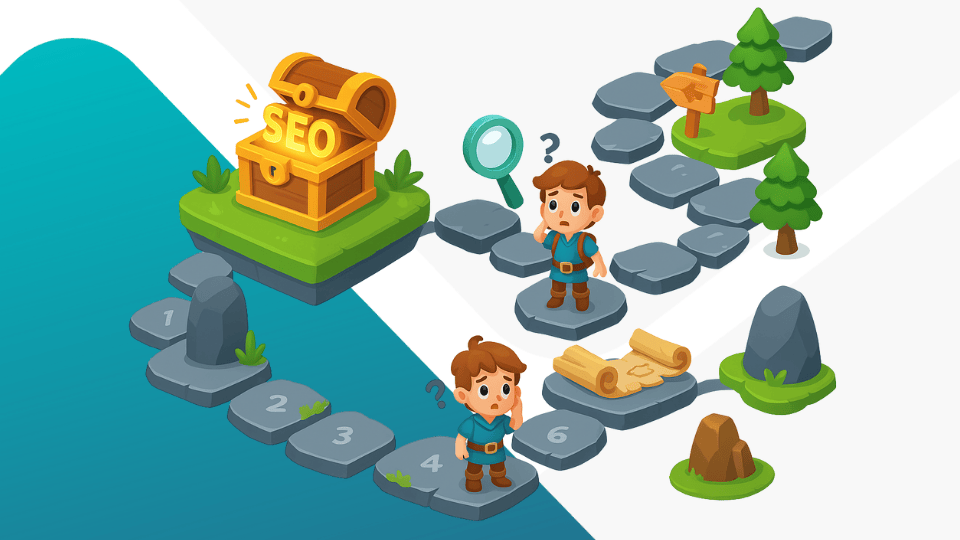

Whether you have no idea what SEO is or trying to find out whether it’s still relevant, you typed something similar to “what is SEO” into Google (or your preferred search engine), and now you’re here. And you’ve either already read enough jargon or carbon copy guides that your eyes are glazed over and you’re ready to give up. Keywords, SERPs, backlinks, meta tags, algorithm updates; what does it all mean and is it even worth it anymore?
I’ve asked myself that same question many times, and I’m IN the industry. SEO is like a game where the rules keep changing and it feels like everyone else already knows the cheat codes. Here’s the simple truth: SEO has always been about one thing – helping people find what they actually need.
At its core, SEO isn’t just about ranking on Google. It’s about clarity. It’s about relevance. It’s about making sure that when someone has a question, a need, a problem, they can find a website (maybe yours!) that answers it well. The tricky part? The way people search has changed and, unsurprisingly, so have the rules for how search engines decide what’s worth showing.
But you probably knew that.
So what is SEO today, and is it still relevant? At the end of this article, you’ll have the answer to your questions.
The Foundation: What SEO Has Always Been
In the beginning, SEO (search engine optimisation) was simple. Almost too simple. Add a bunch of keywords to your page, cram some into your meta tags, and boom – you’re ranking. In fact, for a while, search engines didn’t really care how good your content was. If it had the right words in the right spots, that was enough.
But users got smarter, and if search engines wanted to stay relevant, they had to evolve.
Naturally, it came as no surprise when it suddenly wasn’t enough to stuff the word “best shoes” 200 times onto a webpage and hope for clicks. The internet was exploding with content – and not all of it was good. People needed better answers. And the engines needed better ways to sort through the noise.
And that’s when SEO started to evolve.
The Evolution of SEO: A Timeline of Moving Targets
SEO has gone through more “phases” than fashion in the 2000s. Like fashion, when people and their needs or perceptions change, so does search engine optimisation.
🏁 Early 2000s: When Keywords Ruled the Web
In the early 2000s, keywords were everything, meta tags and backlinks were your best friends, and SEO was a game of quantity over quality. Some pages would repeat the same term dozens (or hundreds) of times on a page to signal relevance, even if it wasn’t relevant to the topic of the content at all.
Want to target more than one keyword? Use them repeatedly in white, on white backgrounds. Yes, that really happened – in fact, some sites still do it, even though keyword stuffing and tag manipulations count against you now.
The end result? Pages that ranked high but gave the same experience as a tequila hangover. Cluttered layouts, content that totally missed the mark, and entire paragraphs that would read “summer shoes best summer shoes buy shoes.”
Not fun or helpful, and it only got worse when content farms and link schemes starting taking over in the mid 2000s.
🤠 Mid 2000s: The Wild West of Content Farms and PBNs
It was the absolute “Wild West” of SEO. Sites like eHow, Demand Media, and others churned out low-effort content purely to match trending queries. The goal wasn’t great content; it was ranking, and ranking well.
Even though you could make the argument that content did improve somewhat, results were still flooded with thin, repetitive articles that didn’t contain any real answers – just keyword soup. Browsing on mobile? Good bloody luck; no one cared.
🔎2010 – 2020: The Google-SEO Crackdown
It was in the early 2010s where Google finally seemed to have enough on behalf of it’s users. Major algorithm updates, like Panda (2011, causing some sites to lose around 80% visibility) and Penguin (2012), cracked down on low-quality content and shady link practices. Later, Mobilegeddon (2015) pushed mobile-first indexing, marking the beginning of user-first SEO. (Go read some of those articles, we dare you. I’ll even get you started with this post from Search Engine Land.)
Then, in the mid 2010s, things started to get really interesting. Search engines began to understand context, not just exact phrases. The rise of voice search, smarter AI (hello, RankBrain), and user behavior tracking changed everything.
Now, Google could understand how “how to fix a leaky faucet” and “DIY plumbing tips” could be answered by the same article, even if the quote-unquote keywords weren’t the same. Long-form content started performing better, topic clusters and content hubs became a thing, and featured snippets finally appeared on the scene.
For users, this meant getting better answers, faster. Voice search and mobile assistants became part of daily life. Search started feeling smarter and, as machine learning matured, Google prioritised intent and experience over word count or tricks.
SEO had to shift from “What keywords can I rank for?” to “How can I solve this person’s problem better than anyone else?”
🧠 2021–2024: Trust, Technicals & the AI Era
While SEO has been getting more complex, it’s also become a lot more human-centered. Google’s focus turned to user experience, content quality, and trustworthiness in a world filled with AI content.
We’ve seen the introduction of Core Web Vitals for page speed and visual stability, EEAT (expertise, experience, authoritativeness, and trust) for content credibility, and the Helpful Content Updates to crack down on fluff and AI-noise. Search became a lot more curated, with pages that are fast, readable, and written by experts earning those coveted top spots.
In short, Google stopped relying solely on keywords and started looking at who wrote the content, why, and how it performed.
🌱 2025 and Beyond: Usefulness, Experience, and Trust
We’ve arrived at a place where SEO is no longer just about “ranking well,” but serving well. In fact, as search engines like Google start prioritising intent matching, usefulness, performance, and trust signals, search feels more tailored and well-organised.
We’ve entered the age where it’s less about optimising for search engines, and more about optimising for users – the way it should always have been. Yes, search engines still need to understand what’s on your page, but the more these algorithms learn what users want, the more you’ll achieve by just optimising for users to begin with.

Of course, just optimising for ‘Google’ isn’t enough….
SEO Isn’t Just One Platform
When most people say search engine optimisation, what they really mean is “Google optimisation.” And look, fair enough. Google still owns the lion’s share of the search market, and for many businesses, it is the battlefield.
But the digi-world of search engines isn’t a one-player game anymore.
🌀 Bing has quietly leveled up, especially after integrating AI into its search interface and Windows OS. With Microsoft Copilot now baked into so many workflows, people are discovering and interacting with content through Bing without even realising it.
📱 Mobile search continues to dominate. In fact, over half of all web traffic is mobile. If your site isn’t fast, responsive, and easy to navigate on a phone, your rankings – and bounce rates – will reflect that.
🖼️ Image search, video SEO, and even TikTok and YouTube Shorts are redefining how people look for information. For younger audiences, search starts on social platforms. They’re not googling “how to style curtain bangs” they’re looking it up on TikTok.
🎙️ And then there’s voice search and AI-powered chat interfaces like Google’s SGE and ChatGPT. These don’t just change where people search, they change how people ask questions, too.
So if your SEO strategy begins and ends with Google Desktop, you’re missing a massive part of the picture.
SEO Today: A User-First, Tech-Second Practice
It might still be called Search Engine Optimisation, but let’s be honest – that name doesn’t quite cut it anymore.
Because now, you’re not just optimising for robots; you’re optimising for humans, devices, contexts, and experiences. You’re creating content that’s:
- Useful to the reader.
- Technically accessible to the crawler.
- Seamless to experience on any device.
- Trustworthy enough to earn clicks – and keep them.
If SEO used to be about keyword placement, today it’s about problem-solving. It’s about showing up for your audience when it matters most, in the most helpful, intuitive way possible.
Think of it like this:
🧭 SEO = Search Engine Optimisation
🤝 SEO in 2025 = Search Experience Optimisation
The engine still matters – but the experience is what sticks.
Unfortunately, it’s not just the user experience you need to worry about. With search engines now using features like AI Overviews, even the top ranking websites have started getting bumped down on the ‘first page’ rank list. So you have to be good enough for a search engine to punt your information through the AI overview, while also appealing to the human being waiting for information on the other end.
If you’re feeling a little confused and wondering, “Okay, so if great SEO can’t even guarantee that I’m going to rank, what the heck should I do?”, don’t worry. We’ve all had this crisis of ‘faith’ at some point in our careers as SEOs.
Aside from diversification, ads, multi-, omni-channel marketing approaches, and every sprinkle on a hot fudge sundae, you can still benefit from a great website and search engine optimisation. Just remember to always ask yourself this:
“Would I find this useful?”
If not…. well then. That answers the question, doesn’t it?
Let’s Put Things Into a Facts and Figures Perspective
🔢 Over 90.6% of all global search traffic still goes through Google, but Bing’s market share jumped by over 10% since the introduction of AI-powered Copilot and integration into Windows 11. To top it off, there’s a good chance that Bing’s popularity will continue to grow, particularly with your audience under 30.
📱 61.5% of all website traffic comes from mobile devices, and that number keeps rising.
⚙️ Google’s algorithm reportedly uses over 200 ranking signals, but most of them boil down to three simple questions:
- Is this content helpful?
- Is this website technically sound?
- Can users trust it?
📹 Video search is exploding. YouTube is the second-largest search engine in the world. And with YouTube Shorts, TikTok SEO, and Instagram Reels, search is becoming more visual, and more contextual, than ever before.
🌍 Voice search usage is expected to surpass 1 billion queries per month globally in 2025, especially for local and on-the-go results.
So… What Is SEO in 2025?
It’s not about chasing algorithms.
It’s not about pleasing machines.
It’s about connecting with real people, in real moments, with real value.
SEO in 2025 is:
- A blend of content strategy, technical excellence, UX design, and trust-building.
- A constantly evolving practice that mirrors how we evolve as users.
- A commitment to showing up usefully – not just showing up.
- Targeting multiple ‘search engines’, including Google, Bing, TikTok, and others.
So if you’ve been overwhelmed or burned out by all the noise around “best practices” and ever-changing updates, here’s the takeaway:
👉 Be helpful. Be relevant. Be clear. Be fast.
If you do that? You’re already ahead of the curve.
And remember this: at the end of every search is a human.
🧠 Ready to Rethink SEO for 2025?
Whether you’re building your first website or refreshing a legacy brand, now’s the time to align your digital presence with how people actually search. At Anima Creative Studio, we don’t chase trends; we build SEO strategies that grow with your brand and evolve with your audience.
✨ Need help untangling your SEO?
✨ Want to future-proof your content strategy?
✨ Curious what “search experience” looks like for your site?
Let’s talk.

